The Complete Guide to the Malaysia Tech Entrepreneur Program (MTEP) - 2025
Complete guide to the Malaysia Tech Entrepreneur Programme (MTEP) visa for foreign entrepreneurs and tech founders. Learn about eligibility, requirements, application process, fees, benefits, and everything you need to know about building your startup in Malaysia.

Hi there! 👋
I'm Dylan, Founder & CEO at foundingbird.com and a fellow MTEP entrepreneur. Thank you for checking out this guide — I've put a lot of time into creating it!
When I first applied for the Malaysia Tech Entrepreneurship Program (MTEP), I was impressed by the program's thoughtful design and efficient application processes. However, I noticed that information and community support around the program were somewhat limited. Having been on the pass for a couple of years and experienced firsthand what it takes to start a company in Malaysia, I now assist other entrepreneurs in navigating this journey.
I hope with this guide I can answer some questions you may have and help you decide whether the program is right for you.
Best, Dylan Damsma
1. An Introduction to MTEP
What is Malaysia Tech Entrepreneurship Program (MTEP)?
The Malaysia Tech Entrepreneurship Program is a visa program specially designed to attract tech / startup entrepreneurs, both new & experienced, to build their startup in Malaysia. The visa allows foreign entrepreneurs to reside and establish their business in Malaysia.
It was started as a program by MDEC, which is short for Malaysia Digital Economy Corporation, to attract tech entrepreneurs and strengthen the local startup ecosystem. MDEC's primary goal is to make Malaysia the preferred hub for digital businesses and talents.
Who is the Program For (and Not For)?
The visa program is designed for new and experienced startup / tech entrepreneurs who are developing proprietary software or technology aimed at improving or solving problems in various industries. These industries include, but are not limited to, AgriTech, HealthTech, Drone Technology, FinTech, Cybersecurity, Smart Cities, Mobility, AI and Robotics, Blockchain, and Big Data.
It's important to note that the key word here is "proprietary technology (software/hardware)". Consulting services, trading / retail, software integrations, etc do not qualify as activities for the program, even if they are in the aforementioned industries.
If you're not sure if your activity qualifies, you can schedule a consultation with me to go into your specific use-case.
2. The Two Types of Visas, Benefits & Criteria
Under this program, there are 2 different visa’s being awarded to tech entrepreneurs:
New Tech Entrepreneur
For tech founders with no track record of any prior startup, established business or successful exit. It’s generally expected that you do have a tech background. If you never worked in tech, at a startup, never developed a product, etc - you may have a harder time convincing the panel.
Type of pass: Professional Visit Pass (PVP) Duration: Max. 1 year + renewable by 1 year Application fee: Roughly MYR 2,700
Notes:
- Once you completed 2 years New Entrepreneur with achievement, you may apply for Established Entrepreneur
- Up to 2 co-founders max.
- No dependents allowed
- It’s required to get a contract with one of the approved Malaysia Digital Hubs (co-working spaces)
- Company listed on visa will be: Malaysia Digital Economy Corporation (MDEC)
Experienced Tech Entrepreneur
For entrepreneurs who have at least 3 years track record of building / running their own established business and can show at least 2 years of financials of that company. For example entrepreneurs who have previously had a successful exit or been running the company for the past 3 years and are looking to expand / move to Malaysia.
Type of pass: Residence Pass (RP) Duration: 5 years - renewable Application fee: Roughly MYR 5,400
Notes:
- Allows for dependents (Spouse & Children - allowed to work)
- In some circumstances allows for bringing parents, parents-in-law, partner under common law marriage, etc. See the official FAQ. - Not allowed to work.
- This pass makes it easier to open personal bank accounts, get loans, etc. as you’re considered ‘full resident’ in Malaysia.
It’s not required to have a degree for either program; however, if you do not have any qualifications from an institution of higher education (i.e. diploma, bachelor’s, master’s, or PhD), you will need to justify your capability by demonstrating how you have acquired the knowledge to start the proposed company.
3. How Does It Compare Against Digital Nomad Visa & MD Status
MDEC has two other programs that seem somewhat similar but serve different target audiences. I often get asked what’s the difference between MTEP and the other two programs and what is the “better option”. The answer, as usually is with these things, depends. That said, I have tried to outline the differences below and a few simple questions that can help you determine which is the best option.
Digital Nomad Visa (DE Rantau)
This visa is designed for remote workers, freelancers, and independent contractors. To qualify, you should already have an existing job or contract with a minimum annual income of USD 24,000 for tech professions or USD 60,000 for non-tech professions.
If you plan to stay in Malaysia for up to 24 months while working for overseas clients or your foreign employer, this program is ideal for you. However, it's important to remember that working for a Malaysian company is not permitted under this program.
So if your intention is to start your own business in Malaysia, then this may not be the right program to apply to.
Malaysia Digital (MD) Status
The Malaysia Digital program is a little bit different than both the MTE & Digital Nomad programs. As in itself it is not a visa program, but rather a status that a company incorporated in Malaysia can acquire.
The goal of the program is to encourage and attract companies and talents in the digital / tech sectors in Malaysia and provide incentives & certain privileges to such companies to achieve this.
The companies business nature needs to be aligned with the promoted activities under Malaysia Digital, thereby there are certain conditions like operating expenditure & hiring requirements.
Under this program, it is possible to get a pre-approved allocation for so called “Foreign Knowledge Workers” which is an individual who holds one or more of the following criteria:
- Holds a tertiary qualification from an institution of higher learning (in any field); or
- Holds a diploma in multimedia/ICT or another specialised ICT certification plus at least 2 years’ relevant experience in multimedia/ICT or an equivalent field; or
- Has held a professional, executive, management or technical work position in information technology (“IT”) enabled services (e.g. IT / IS Professionals, Finance / Accounting, Business Administration)
If these criteria are met and you have been able to acquire MD status, it would be possible to apply for employment pass for either yourself or employee(s) you intent to hire. However, having been granted MD status does not automatically grant you the visa itself. You will still need to apply and go through the employment pass application process.
So when does it make sense to go the route of MD status instead of MTEP? Well, that does depend a little bit on your situation. However, I’d say the main factor in answering that question would be what type of business you’re starting.
It is totally possible for a company started by an MTE pass holder to apply for MD status. Therefore, also it would be possible to switch your MTE pass to an employment pass under the MD Foreign Knowledge Worker program. (This may be preferred over a New Entrepreneur pass if you want to bring dependents. But for experienced entrepreneurs we strongly recommend the MTE pass)
That said, to establish a company it is required to have at least 1 director who ordinarily resides in Malaysia. Therefore, if you are a solo founder and/or all founders are foreigners, it becomes paramount to first get a visa before you can incorporate your company. — You can see the chicken & egg problem 🥚🐓 that you might run into if you wanted to take the MD route.
If you’re starting a company with it’s own proprietary software/hardware in any of the target MTEP sectors, we recommend applying for the MTE pass first. However, if you do not have any proprietary tech, yet your primary business nature is in one of the following sectors:
- Digital Agriculture
- Digital Services
- Digital Cities
- Digital Health
- Digital Finance
- Digital Trade
- Digital Content
- Digital Tourism
- Islamic Digital Economy
Then you may want to consider incorporating a company using a local partner and/or nominee director (a service we can provide) and then applying for MD status.
4. Nationalities with Potentially More Risk
Before we dive into the application process and all the exiting stuff that comes after it, it’s important that we address a potential issue for entrepreneurs from any of the listed high-risk jurisdictions below:
*Countries on the UNSC/FATF lists or flagged countries such as India, Indonesia, Iran, Iraq, Afghanistan, Sri Lanka, Syria, Myanmar, Nicaragua, Pakistan, Panama, Senegal, Uganda, Yemen, Zimbabwe, Albania, Algeria, North Korea (DPRK), Burkina Faso, Cambodia, Cayman Islands, Ghana, Mexico, Colombia, Botswana, Barbados, Jamaica, Mauritius, Kazakhstan, Russia and Israel.
Note: If your country is not listed above, but you’re from a country where there’s an ongoing conflict, political tensions or you’re not sure if you’re from a high risk jurisdiction - do consult us.*
While applying for the visa and incorporating a company as a national of one of these countries may not be an issue (exception for Israeli’s whom require special approval), banking and access to financial institutions can be extremely challenging.
That does not mean it is completely impossible, as we have assisted clients from these jurisdictions to access bank accounts before, however prior consultation is extremely important.
Of course, it would be a shame to apply for a visa, move to Malaysia, incorporate a company and then find out that opening a bank account for your company is not possible. Extremely frustrating in fact.
Therefore, If you are from one of these countries, I recommend scheduling a consultation call to discuss your options. Whether they work for you or not is entirely dependent on your personal situation and we can’t really give any advise without going into the details.
5. Application Process
What Documents to Get
Malaysia Digital Hub
[Content to be added based on Notion page]
Personal Bond
[Content to be added based on Notion page]
How to Apply
[Content to be added based on Notion page]
Fee Structure
[Content to be added based on Notion page]
The Pitch Deck
[Content to be added based on Notion page]
Timelines
[Content to be added based on Notion page]
6. Support & Resources
[Content to be added based on Notion page]
7. Grants, Loans, Funding
[Content to be added based on Notion page]
8. Incorporation
[Content to be added based on Notion page]
9. Taxes & Corporate Compliance
[Content to be added based on Notion page]
10. Banking
[Content to be added based on Notion page]
11. Renewal Process
[Content to be added based on Notion page]
12. Living in Malaysia
[Content to be added based on Notion page]
13. Hiring in Malaysia
[Content to be added based on Notion page]
14. Paying Yourself
[Content to be added based on Notion page]
15. Communities to Join
[Content to be added based on Notion page]
16. Service / Service Providers
[Content to be added based on Notion page]
17. Case Studies and Success Stories
Interview MTEP Pass Holders
[Content to be added based on Notion page]
18. A Comparison Against Other Countries
Singapore
[Content to be added based on Notion page]
Thailand
[Content to be added based on Notion page]
Other Countries
[Content to be added based on Notion page]
19. FAQ
Driving License
[Content to be added based on Notion page]
Getting the Visa Endorsed in Passport
[Content to be added based on Notion page]
General Questions
[Content to be added based on Notion page]
Get Started with MTEP
Ready to begin your MTEP journey? Contact Foundingbird today for a consultation. We can help you:
- Determine if your business qualifies for MTEP
- Prepare your application and pitch deck
- Connect you with Malaysia Digital Hubs
- Incorporate your company in Malaysia
- Set up banking, compliance, and ongoing business support
This guide is maintained by Dylan Damsma, Founder & CEO of Foundingbird. For questions or updates, please contact us at foundingbird.com.
Table of Contents
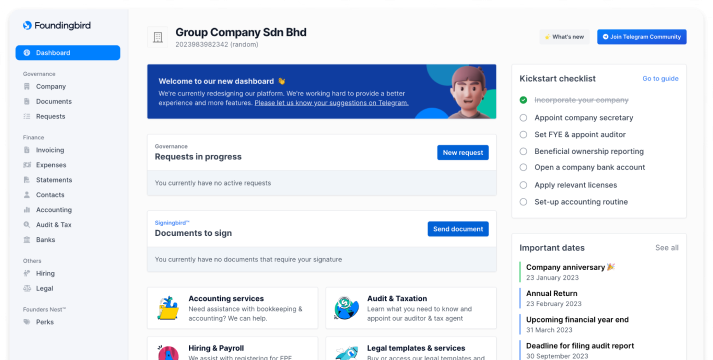
We're the most convenient online platform for starting & managing a Sdn Bhd
- Incorporation of Sdn Bhd
- Company secretary
- Accounting & Bookkeeping
- Audit & Taxation
- HR & Payroll
Need More Help?
Explore our other guides or get in touch with our team.